















































































































































































































































































































































































































NASA’s Swift Space Telescope Re-enters Earth’s Atmosphere

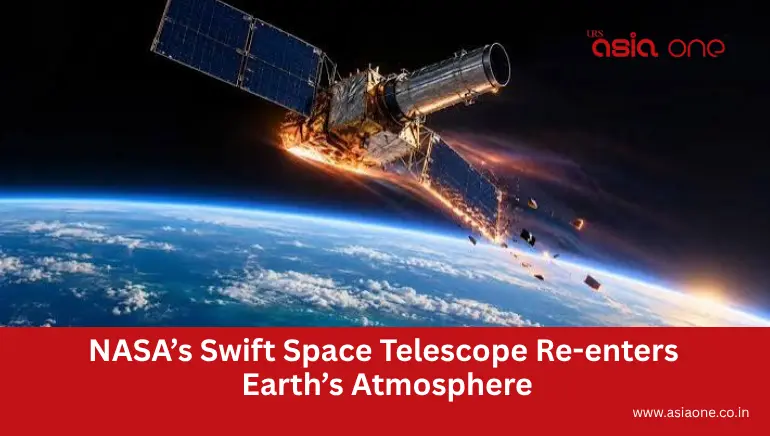
NASA’s Neil Gehrels Swift Observatory re-entered Earth’s atmosphere on November 4, ending a space science mission that operated for almost 22 years.
The US Space Force confirmed that the spacecraft re-entered at 7.39am Eastern Standard Time over the North Sumatra region of Indonesia. NASA expected most of the observatory to burn up during its descent, although some components may have survived.
Swift was launched in November 2004 to study gamma-ray bursts, among the most powerful explosions in the universe. The observatory carried three telescopes that allowed it to detect and examine cosmic events across ultraviolet, optical and X-ray wavelengths.
Its original primary mission was designed to last two years. However, the spacecraft continued operating for more than two decades, observing a wide range of astronomical objects and events.
Swift’s instruments enabled researchers to identify gamma-ray bursts and rapidly direct its telescopes towards their locations. It also sent alerts to other observatories, allowing scientists around the world to conduct follow-up observations.
NASA ended the mission’s scientific operations in October 2026 after the spacecraft’s orbit had declined to approximately 275 kilometres above Earth. Increased atmospheric drag, partly associated with heightened solar activity, accelerated its descent. The observatory could no longer maintain stable pointing towards astronomical targets.
The operations team sent the final command to end Swift’s scientific activity after its last observation on October 20.
During its mission, Swift contributed to research on supernovae, active galaxies, stars and other high-energy cosmic phenomena. Its observations also helped scientists understand the origins and behaviour of gamma-ray bursts.